European Court Delivers Landmark Climate-Change Decisions: An Access to Justice Perspective (part II)


To read part one of this two-part blog post, click here.
The ECtHR judgments in these historic climate cases will have far-reaching consequences particularly for those seeking access to justice for climate related harms. Therefore, while these complex judgments affect a lot of issues, the second part of this blogpost will focus on their implications for access to justice in the context of climate change.
Three important developments seen in these cases are the Court limiting access to justice with respect to the extraterritorial effects of GHG emissions, adopting a restrictive approach concerning access to justice for individuals harmed by climate change effects, and employing an expansive approach for NGOs’ access to justice in climate litigation.
1. Limiting access to justice with respect to the extraterritorial effects of GHG emissions
Under the ECHR, complaints can only be put forward by individuals against a state that holds jurisdiction over them, either because they reside in the territory of the State or because the State otherwise exercises effective control over the applicants. In the Duarte Agostinho case, the applicants, all of them residing in Portugal, argued that extraterritorial jurisdiction could be established because, in the context of climate change, the 33 States against which the complaint was directed hold “effective control over their interests.”
However, the ECtHR argued that this criterion cannot be considered as a basis for extending extraterritorial jurisdiction, as it would lead to a “critical lack of foreseeability of the Convention’s reach” (paras. 205-206). The Court asserted that under the applicants’ reasoning, individuals located almost anywhere in the world could submit claims for States’ failure to mitigate climate change. Moreover, it referred to the difficulty of establishing the respective contributions to the adverse impact of GHG emissions abroad, due to the complexity and unpredictability of the chain of effects that results in such an impact. Therefore, the ECtHR considered that the applicants were not subject to the jurisdiction of any State other than Portugal.
Notably, this is a different interpretation of the reach of jurisdiction than the one put forward by the Inter-American Court of Human Rights. In an Advisory Opinion of 2017, it found that to establish jurisdiction in cases of transboundary harm under the American Convention on Human Rights, individuals are considered to be subject to the jurisdiction of the State where such harm originated. Such an extraterritorial reach of jurisdiction in climate-related cases was also held by the UN Committee on the Rights of the Child in the case of Sacchi and others. The ECtHR acknowledged its divergent interpretation but upheld it on the basis of differences in their respective notions of jurisdiction.
2. Access to justice for individuals in the context of climate change
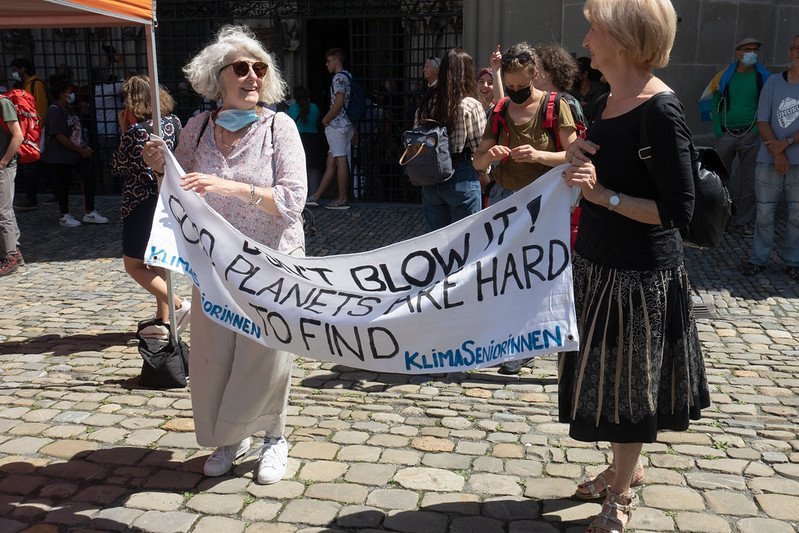
The KlimaSeniorinnen case was by far the most impactful of the three for several reasons. In this case, ECtHR adopted a rather restrictive approach concerning the legal standing of individuals claiming a violation of their rights due to climate change. This is based on the requirement of a ‘victim status.’
To submit a complaint to the ECtHR under Article 34 of the Convention, there needs to be a “direct impact” on the applicant caused by the State’s acts or omissions. In the context of climate change, the ECtHR recognised that “everyone may be, one way or another and to some degree, directly affected, or at a real risk of being directly affected, by the adverse effects of climate change”, which would allow an indefinite number of persons to claim victim status and submit climate-change related complaints (para. 483).
For that reason, the ECtHR considered that to establish legal standing, it must rely on the particular circumstances of the individuals in question, determined by the risk of adverse consequences of climate change affecting them. Thus, individual applicants must show that the failure of States to combat climate change affects them personally and directly, due to the intensity of exposure to the effects of climate change and the absence of adequate measures to prevent harm. According to the Court, “the threshold for fulfilling such criteria is especially high” (para. 488).
In the KlimaSeniorinnen case, it found that this was not applicable to the individual claimants, because they did not suffer “from any critical medical condition whose possible aggravation linked to heatwaves could not be alleviated by the adaptation measures available in Switzerland” (para. 533). In sum, by restricting access to the Court in cases of transboundary harm and with respect to individuals in the context climate change, it can be observed that the ECtHR is trying to avoid a flood of climate change claims reaching it in the near future.