


Luca Brocca
Just Access Representative to the UN Convention Against Corruption
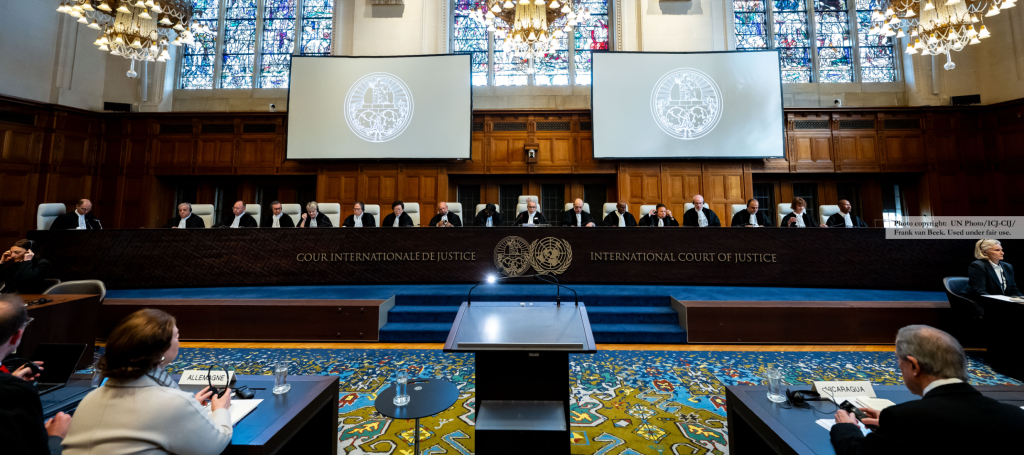
Imagine a scenario where humanitarian aid collides head-on with military support in one of the world’s most contentious conflicts. That’s precisely what Nicaragua is claiming at the International Court of Justice (ICJ), where it is accusing Germany of fuelling violence in the Israel-Palestine conflict.
On Monday, the 8th of April 2024, Nicaragua brought a case to the ICJ, asking it to compel Germany to cease all arms exports to Israel. Nicaragua, which has historical connections with Palestine, contended that Germany’s provision of military aid to Israel constitutes a violation of the 1948 Genocide Convention, as well as other norms of international humanitarian law. This plea follows a prior ICJ ruling in January, which suggested Israel may plausibly have contravened certain aspects of the convention.
Carlos Arguello Gomez, Nicaraguan Ambassador to The Netherlands and head of Nicaragua’s delegation, emphasised in his opening statement that “serious breaches of international humanitarian law, including genocide, are occurring in Palestine.” In such circumstances, he urged other nations to refrain from taking actions that “assist the perpetrator.”
Serious breaches of international humanitarian law, including genocide, are occurring in Palestine
Nicaragua is also urging the ICJ to require that Germany resume funding for the United Nations Relief and Works Agency for Palestinian Refugees (UNRWA), in addition to the aid it already provides. Addressing the ICJ, Daniel Müller, a member of Nicaragua’s legal team, criticised the situation as both disheartening and contradictory since Germany offers humanitarian aid, including airdrops, to Palestinian children, women, and men in Gaza while simultaneously supplying weapons and military equipment used to harm and annihilate them.
Germany ranks second only to the US in supplying arms to Israel, according to the Stockholm International Peace Research Institute (SIPRI). Between 2019 and 2023, the SIPRI found Germany was responsible for 30% of Israel’s arms imports and the US accounted for 69%. In 2023 alone, the US sent $353.7 million worth of military equipment to Israel.
However, bringing the U.S. before the court is difficult, if not impossible, as it doesn’t recognise the ICJ’s authority to compel nations to appear before it. Additionally, the US has not ratified the protocol to the Genocide Convention that permits countries to bring disputes before the court.
Germany asserts it diligently fulfilled its responsibilities toward both the Israeli and Palestinian populations
During the ICJ proceedings in The Hague, Germany’s Agent, Tania von Uslar-Gleichen, firmly rejected Nicaragua’s accusations, describing the case as grossly biased. She emphasised that Germany has diligently fulfilled its responsibilities toward both the Israeli and Palestinian populations. She also cited the Nazi Holocaust against Jews during World War II as historical context justifying the centrality of Israel’s security to German foreign policy.
Christian Tams, a member of Germany’s legal team, refuted claims that Germany’s suspension of UNRWA funding hinders aid delivery to Palestinians in Gaza. He asserted that Germany continues to provide essential humanitarian support under challenging circumstances. Tams also clarified that, since October 2023, exports to Israel primarily consisted of other military equipment, typically of a subordinate or defensive nature, rather than artillery shells or munitions.
Nicaragua has long been a staunch supporter of the Palestinian cause, viewing it as a contemporary manifestation of the colonialism it endured during Spanish rule. However, Germany contested this stance during Tuesday’s proceedings, asserting that the ICJ lacked jurisdiction since Nicaragua’s case primarily targets Israel and its alleged violations of international law.
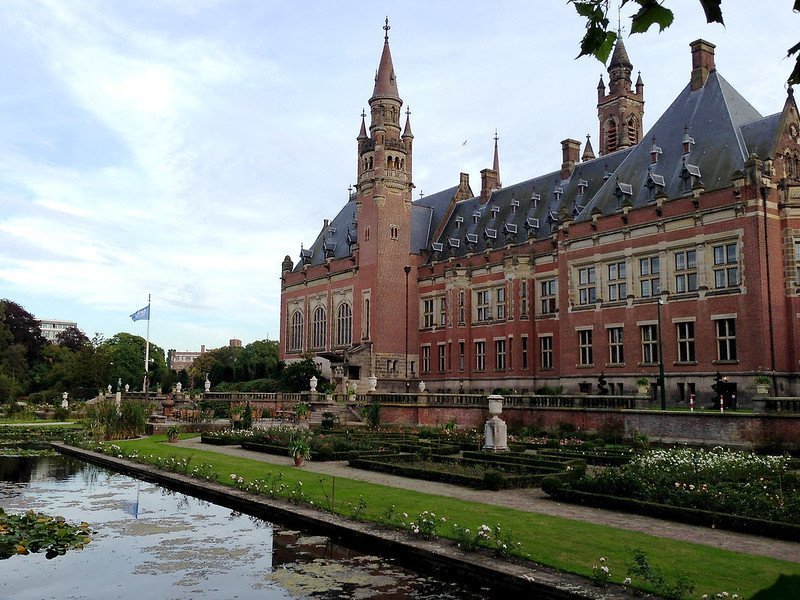
Image credit: R Boed via Flickr. CC-BY-NC 2.0
British lawyer Samuel Wordsworth, representing Berlin, emphasised that the case against Germany hinged entirely on a prior determination of Israel’s breach of international law in Gaza. Notably, the ICJ is concurrently handling a separate case brought by South Africa against Israel, where it issued an order in January for Israel to “take all measures” to prevent genocide in Gaza. But it has yet to render a verdict on whether Israel is committing genocide.
Given these factors, Germany’s legal defence appears robust. However, this case holds significant importance as it highlights the European Union’s and its member states’ controversial positions during this conflict—distinct from their unwavering support for Ukraine in the face of Russian aggression.